
Chlorine
by Lea Ervin
It was the day my mom said she dropped me off at the pool as a little girl, and I walked out a woman.
It was the summer I turned 13, and I was meeting A. at the Helena Country Club pool, like I had done every summer for as long as I could remember. Swimming was our daily ritual during Mississippi Delta summers—essential as breathing.
The steam from the heat mixed with morning dew and gathered around my feet like a sauna. I squinted against the bright sun as I stepped through the metal gate, which screeched its familiar hello when I crossed the threshold.
A.’s mom always saved me a chair. I dropped my towel and pool bag there, claiming my spot before peeling off my tank top and shorts to reveal my first-ever bikini. It was yellow, blue, and pink—colors swirling together like watercolor on fabric. My mom had bought it from The Gumdrop Tree, a local children’s boutique. It would be her last purchase for me there; I was ready to move on to the juniors section at Goldsmith’s in Memphis.
Despite the straps biting into my shoulders, the underwire holding up nothing, and the tight Lycra bottoms pressing into my hips, I wore that suit with pride. I was finally a teenage girl.
The pool reeked of chlorine, sunscreen, and Lycra. My black hair never turned green like A.’s, but it dried stiff and straw-like. After each swim that summer, I sat on the toilet lid while my mom combed through the knots, starting at the ends, working her way up. That day I could expect the same. A. and I swam until our fingers and toes pruned, our feet blistered from the rough surface of the pool bottom. The water felt like home, and the only place I didn’t feel perceived. Or maybe I did, but I didn’t care.
We played Shark, held underwater tea parties, and used the diving board as our catwalk. We flipped, splashed, laughed, and competed to see who had the best George Washington hair. Our moms ran errands or gossiped or did whatever moms did on their breaks from us.
We existed in the strange limbo between childhood and womanhood. We still played games, but we also wanted the junior high football players, with their newly minted biceps and summer abs, to notice us.
After a quick plunge, I met A. at our chairs. She was applying tanning oil that smelled like a piña colada left to melt in the sun. Sunscreen was foreign to us; we wanted the deepest bronze possible, something that would last through football season. Cheerleading uniforms didn’t look as cute with pale legs.
I dug through my pool bag for the library book I’d checked out the day before—a collection of Joyce Carol Oates stories. I dried my hands so I wouldn’t dampen the pages.
“What are you reading?” A. asked.
“‘Where Are You Going, Where Have You Been.’ It’s what Momma says happens to girls who get too wild.”
“Huh. That’s definitely not you then,” she laughed.
She was right. I was too good. Too polite. Southern girls learn early how to smile through everything.
But I also had a fascination with the dark. My grandfather had been a sheriff’s deputy in the 70s. I would sit in his lap and he’d tell me stories of his adventures in law enforcement. One story that stuck with me was if you threw a body into the Mississippi River, the giant turtles would eat it, and it’d never be found.
But the pool wasn’t the river. It was clean and bright and merciless. No matter how deep you swam, you were still visible. And that was the trouble. You didn’t know you were being watched until you understood what it meant to be seen.
Even then, I opened my eyes underwater, though it stung. I loved watching the sunbeams fracture and dance like tiny pieces of sky trapped beneath the surface. I think I already knew those pool days were golden, and I was swimming in something I wouldn’t be able to get back.
It felt like I had done something wrong just by growing. I could feel the eyes, even under the water. Especially under the water. No one teaches you how to handle all that looking. Instead, you just float and let John Rzeznik croon through your ears, And even though the moment’s passed me by, I still can’t turn away…
“Scars are souvenirs you never lose,” and I was already collecting them.
By the end of the summer, I knew which boys would be kind, and which ones would ruin you slowly. I wasn’t bad. I was awake.
That last swim was different. We didn’t race or dunk or perform. We just floated. The water was warm and heavy, like it didn’t want us to leave either.
“Lea, it’s time to go. Let’s get out and dry off.” My mom’s voice rang out sharp and clear, even through the water.
I got out, dried off, said goodbye to A. and her mom. My mom was already in the car, escaping the heat.
That was the day I walked out a woman, and left behind the little girl.
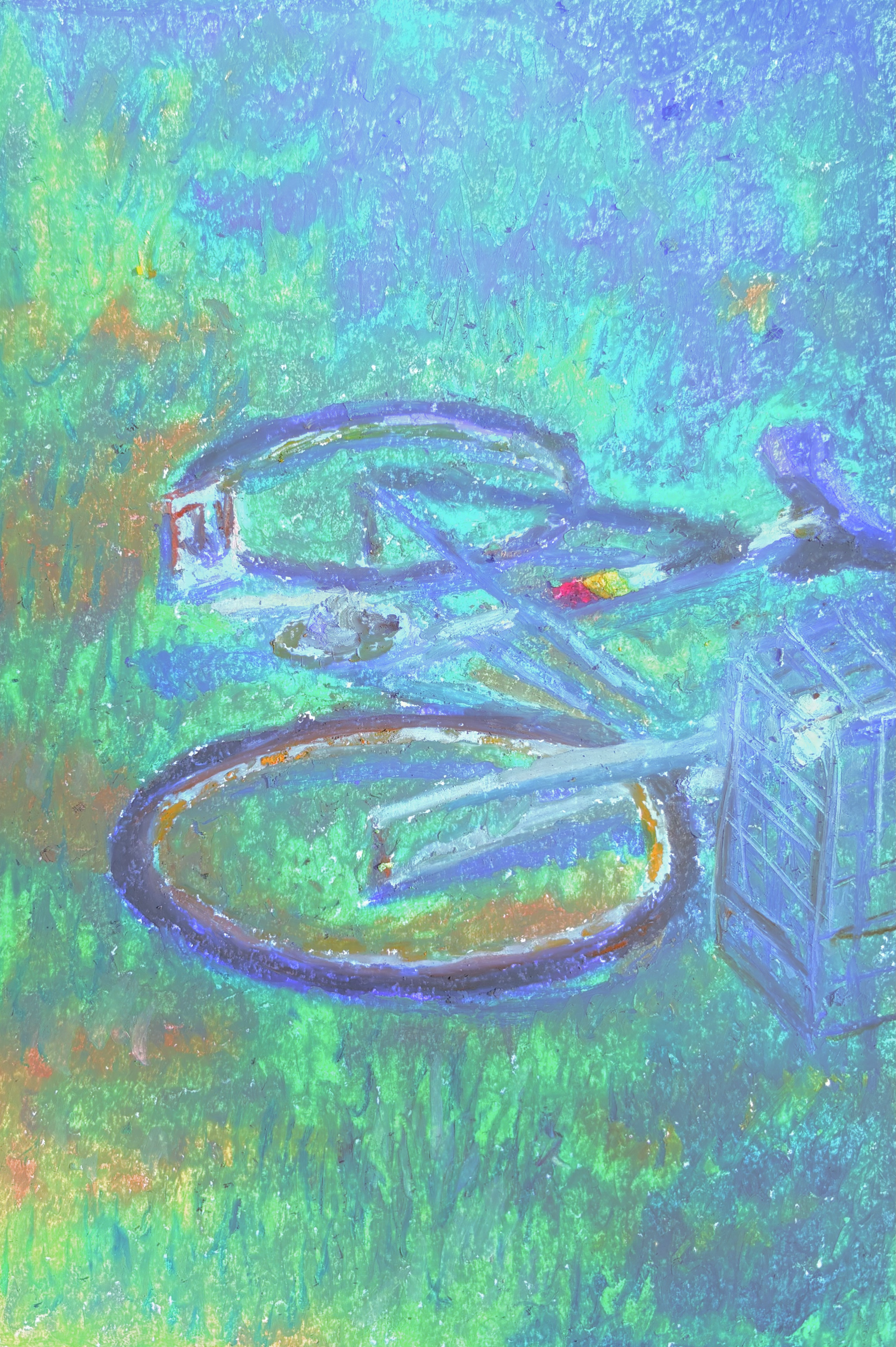
“Bicycle Lying on the Ground” by Violet Lune
Lea Ervin is an MFA candidate in Creative Writing at The City College of New York, where she also teaches Writing for the Social Sciences. Her work explores memory, embodiment, and the aesthetics of longing through essays that blend personal narrative with cultural observation. A native of Eastern Arkansas, she draws inspiration from Southern landscapes and what she calls cabaret surrealism—where glitter meets the unconscious, and identity becomes both mask and revelation. Her writing and artwork have appeared in various magazines, including Marrow Magazine.