
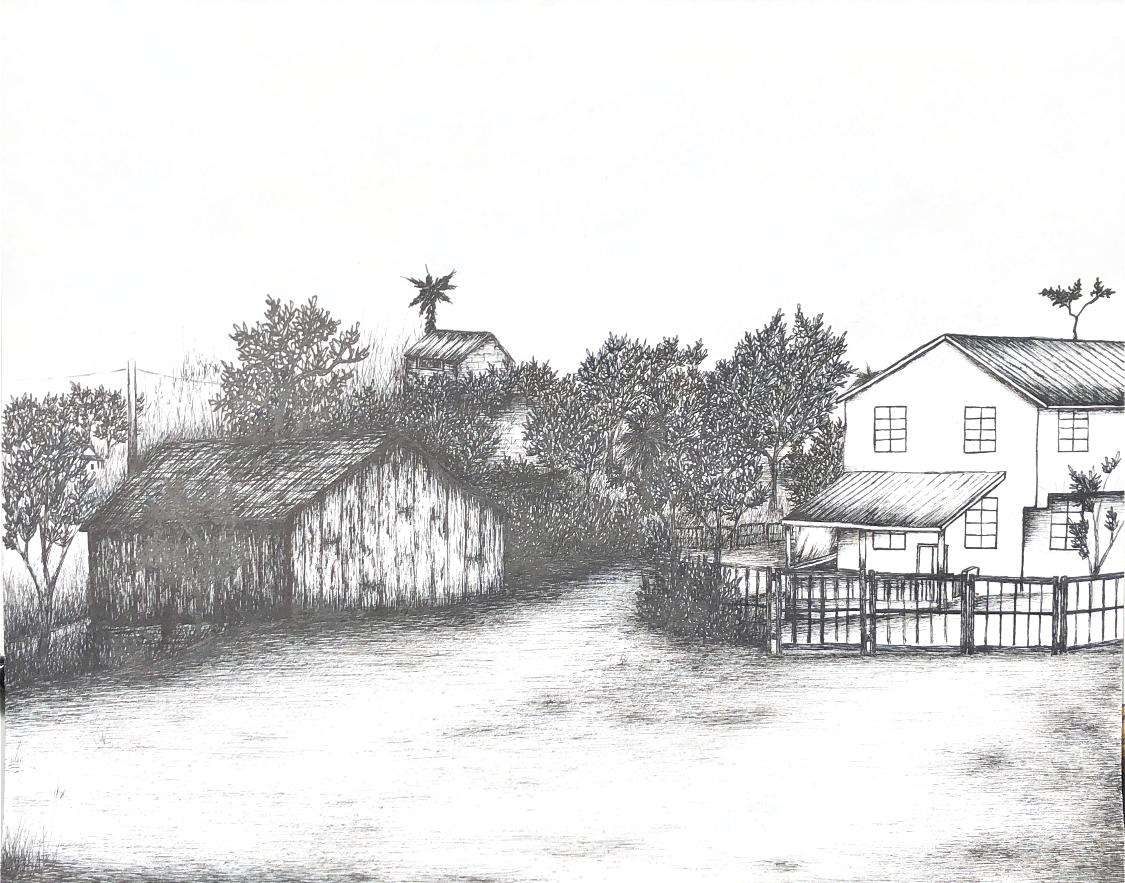
Collect
(an excerpt)
by Griffy LaPlante
This is a story about compost, and it ends—fittingly—with death.
It begins, however, on a Tuesday: the first Tuesday of the month, at six o’clock in the evening. Six o’clock in the evening on the first Tuesday of the month is a time which, if you were in the know, would signify to you that the residents of 77 Lilac Street are almost done with their House Meeting. Outside the moon takes its time to rise, cannot be rushed.
In the living room of 77 Lilac there are many chairs, and the highest-backed one is a half-busted walnut-and-tuffet the housemates long ago christened the “Tyrant’s Chair” for the unearned confidence it tends to bestow onto its occupant—and for the springs that protrude slightly from its cushions, forcing better posture. In the Tyrant’s Chair sits Jules, whose turn it is to be Meeting Tyrant. Jules is the youngest occupant of the house by a year, and with that comes the responsibility to cultivate a certain chaos element, which they attend to devoutly. They have bleached hair and a small stutter, which once attracted bullies but now attracts sexual mates like ex-altar boys to the drag scene. Jules also has a draconic affinity for shiny objects, which they wear on their fingers and in their nose, keep troves of around the house, and leave behind them in a sparkling trail.
Last month, the housemates painted the living room an eggshell white, unable to agree on a more interesting color; none of them are upset or especially pleased about the paint, making it perhaps their greatest democratic achievement to date. This week’s agenda consists of such items as constructing the communal groceries list, investing in more aggressive housefly execution materials, and an updated inventory of the rabbit’s ever-worsening allergies following her recent trip to Dr. Ivanov, whom they all refer to as Hot Vet. In all of these items, today’s agenda is fairly routine, and the meeting is going well, unextraordinary in the way functional democracy is supposed to be. Nothing notable whatsoever takes place until the moment that Elya—twenty-eight and curly-haired, a bit skittish of the world, far too disinclined toward aesthetics to own even a single shiny thing—raises his hand.
“I would like to propose a chore chart,” Elya says, and he lets his hand return to his lap.
The air in the room shifts around its fidgeting inhabitants. Legs cross and uncross—specifically the legs of Xóchitl and Elspeth, the other two housemates.
“I might be wrong,” Jules says, “but I thought we’d decided against that already. Last fall, if I’m not mistaken. When Elspeth said that thinking about chore charts made her feel surveilled.” Elspeth and Xóchitl nod meaningfully. Thank you, Elspeth mouths to Jules.
“I remember,” a sheepish Elya says. “But I think we should discuss it again.”
“Well, does anybody second Elya’s proposal to reopen the chore chart conversation?”
Nobody does—Elya knew they wouldn’t—so Jules moves along. Elya doesn’t protest, but at the next House Meeting—two weeks later, with Xóchitl as Meeting Tyrant—he makes his suggestion again. This time the reaction from his housemates is swift and unambiguous. It’s like they’ve all agreed that he’s a spoiled child they will no longer humor, which for all Elya knows is exactly what they’ve agreed upon, in an underground House Meeting without him.
Elspeth and Xóchitl seem to have prepared for this inevitability, and one after the other they articulate their rebuttals in fashions true to their mannerisms, the same mannerisms which could themselves be agenda items at House Meetings if Jules and Elya weren’t both a little afraid of them. When Elya tries to defend himself, Jules, who is hungover, takes off their Chelsea boot and throws it at him. Elya ducks, and the boot misses, knocking Elspeth’s framed teaching certificate off the wall.
Elspeth is Meeting Tyrant at the House Meeting after that, so Elya heeds her withering gaze and stays quiet. But two Tuesdays later, Elya proposes chore charts for the third time and immediately finds himself in a war room. Elspeth is on her feet, proclaiming that she can’t do this with him, she can’t, Elya, not anymore. Xóchitl is cursing at him in multiple languages. Jules, in the Tyrant’s Chair again, is at a loss, and they are surprised to find themself thinking of their grandfather, a school principal in Alabama who lived just long enough to become a terrifying figure in Jules’s early life. They feel certain that if their grandfather had been today’s Meeting Tyrant, he would never have allowed things to become so Bolshevik.
“The issue, per se—” this is Xóchitl talking, Xóchitl being the most eloquent resident of 77 Lilac and thus often called upon to speak for multiple of them, though never by Elya, who can’t deny the gravitas of her rhetoric but finds her takes on things contradictory at best— “is not with chore charts themselves, but with what they represent.” Coercion, rigidity. Legal violence. Kyriarchy, racial capitalism, the patriarchy of the wage. She acknowledges that charts can sometimes be helpful, but only when they’re an organic response to their context, and only when derived from the consent of the people. A people which, Elya guesses, excludes him. Elya wants to say that actually the issue per se is that his housemates are not just capable of, but seemingly committed to turning everything, absolutely everything into a terrain of struggle, a collective disposition he secretly blames on the fact that Elspeth and Jules met in a class on transnational Marxist feminisms. Xóchitl might’ve met them there, too, if she hadn’t decided at seventeen that she was too smart and punk for college. Elya and Elspeth met in their mother’s womb.
Instead of saying all of that, Elya says, “I hear you,” which is a lie. “But the fact is that the tasks needed to survive in this house are not getting done. Equitably or inequitably. Have you stepped into the kitchen lately? Forget the flies! Ants! Ants everywhere! We say that whoever is first to see that the compost is full will take it out, but that never happens. It’s always me. Well, it was always me, until recently, when I decided to run an experiment to see if anybody else would step up to take it out if I stopped. And guess what?” Elya, warmed up now, practically leaps from the sofa to the kitchen. When he returns, he is holding the compost bin. He pops its lid off.
“See that?” Elya asks, and it is plain to everybody what they are meant to be looking at: a soggy chocolate mass at the very top of the bin, shot through with red icing like rivulets of blood. “That’s the last piece of birthday cake. Xóchitl’s birthday cake. From weeks ago.”
The effect is the same as if Elya had taken the compost bin and poured its contents all over the coffee table.
It both is and isn’t true that the compost is a particularly delicate subject among these housemates. Not true because, whether they could admit it or not, the present battle being waged in their living room clearly had its roots elsewhere. True because compost is the subject of Elya’s dissertation—he’s getting a PhD in history, specializing in the development of municipalism—and even he isn’t sure how delicate compost, itself, actually is. Conventional wisdom about it contradicted itself. They should compost rice, bread, grains; they absolutely should not compost rice, bread, grains. Coffee grounds are good for compost; coffee grounds will poison it, and the neighborhood cats, too. And on and on. It’s rather illogical, Elya often thinks, that there isn’t a mechanism for feedback when it comes to outsourced composting. The housemates get letters from the city all the time complaining that their front grass is too long, but never that their definition of what’s compostable is a disgrace. Perhaps they ought to receive such a letter, Elya thinks to himself now. One would think that Xóchitl, as the only housemate who works or has ever worked in agriculture, would be at least as opinionated on the compost matter as Elya, who touches dirt exceedingly rarely. But Xóchitl is skeptical about rules and regulations to the point of religiosity and thus approaches composting with a rather libertine philosophy. It seems to serve well both her mental state and the vitality of the farm where she works. But it drives Elya up the whitewashed wall.
When Elya sits back down, compost bin tucked between his legs like a gunmetal silver tail, the sofa has become an icebox, inhospitable to life. Elspeth looks at him with his own face.
“Well, Elya,” she says, “you’ve always had a flair for the dramatic, haven’t you?” Xóchitl takes Elspeth’s hand. Elya, desperate, turns to Jules.
But Jules has not been paying attention, has gone on thinking about their grandfather instead. Silas was his name, though the townsfolk usually called him “Silence,” since that’s what accompanied him everywhere he went. That was the effect he had. He refused to attend church, believing in no God but Education—so said Jules’s mother, who dropped out of high school and ran away from Silas’s quiet home at sixteen—but he was such a scrupulously competent principal that he earned the respect of even his most evangelical students’ guardians. He wore a double-breasted suit jacket every day, including weekends, and in Jules’s memory he always smells like a wildfire. When he was eighty-two, widowed, and confined to his bed by the bone cancer he described as the naggingest itch, he announced to his array of descendants in the room that he was a homosexual, and always had been. Then he smiled a little and fell into an untroubled sleep, from which he slipped gamely into death.
When Jules becomes aware that Elya is looking at them—pleading, really, and pathetically, his eyes milky like a child’s—Silas’s scent of burning brush is still licking at them.
“You know,” Jules says, “maybe a chore chart isn’t such a bad idea.”
Despite the victorious character of Elya’s yelp, the battle is far from won—it’s still two against two, and the chore chart proposal will languish for another two weeks, at least. The meeting ends with neither fanfare nor repair as Jules withdraws into themself as they sometimes do. They all retreat to their bedrooms—Jules to the attic, Xóchitl and Elspeth to the converted sunroom, Elya to the second-story bedroom with his dissertation draft for company.
Elspeth barely waits until the others’ footsteps could be heard creaking up the stairs before commencing her debrief diatribe. “Oh, merciful god, I cannot stand him,” she says, throwing herself backwards on the bed. “That way he’s acting? As if he’s somehow oppressed or something? God forbid the white man of the house has to take the compost out every once in a while. For fuck’s sake!”
Xóchitl latches shut the room’s french doors, drapes from the top of them the gauzy scarf they use for privacy, and follows Elspeth onto the bed. They both take off their shirts, their bras. They unlatch the rabbit’s enclosure and bring her into bed with them, petting her heavily. “To be fair,” Xóchitl says, removing the pins from her hair and letting them fall to the bedspread, “it sounds like it’s more than every once in a while. That Elya takes the compost out, I mean.”
When Xóchitl’s hair comes loose, it falls in dark heaps that reach past her breasts and make Elspeth’s insides hurt. Elspeth reaches a hand out to her, pulling her horizontal, hooking a leg around her thigh to burrow in closer. They both close their eyes and lay like that for a while, until Xóchitl notices Elspeth’s breathing has changed.
“He’s like this because of Mom,” says Elspeth in a cracked-open voice. “I know it.”
For a moment, Xóchitl does nothing. Then she kisses her, full and slow, which she is canonically good at doing. Xóchitl likes kissing Elspeth, but her dirty secret is that it isn’t desire driving these kisses now, or even affection—not to say she doesn’t feel those things, too—but the fact that she never knows what to say when Elspeth brings up her mother, who is also Elya’s mother, and who is dead. And Elspeth brings her dead mother up a lot. Xóchitl is not good with parents, living or otherwise, she is not good with them at all. They put the bunny back into her enclosure and take off each other’s jeans. As requested, Xóchitl puts a hand to the side of and then around Elspeth’s throat, feeling the soft arc of it as she silently wills Elspeth to forget about her mother. Not for long. Just for tonight. Just so they can fuck and, more importantly, sleep.
Elya and Elspeth James haven’t gotten along since they were very small. After their mother was diagnosed, a lifetime or two ago, and they told her they’d decided to move in together in a house near hers, she laughed aloud before realizing they were serious. “Oh, my darlings,” she said, putting a hand to both of their healthy faces, “don’t kill yourselves on my account.”
They hadn’t killed themselves yet, or each other, but from the dawn of their cohabitation both seemed possible. When their mother, Annalise, received that first diagnosis, Elya and Elspeth both flew home from their chosen coasts and never went back. Moving back to Minneapolis was in neither of their plans, and indeed if you’d told them as teenagers that within a few years they’d be back living within a mile of their high school, they might have both killed themselves right then and there. But as the first diagnosis evolved into a second and a third, it became a game of chicken: Who would abandon their filial duties first for their former lives of hedonism and sin? They both had reputations for being impossible to argue with, and in their years apart they’d grown satisfied being the most stubborn person on their respective sides of the Mississippi. Neither would give the other the satisfaction of seeing them break. The day that Elya told Elspeth he’d found someone to take over his lease in San Francisco, Elspeth published a want ad for a subletter on Craigslist: Brooklyn, and she convinced Jules, her roommate and best friend, to move to Minneapolis with her.
The twins never admitted it, but they did feel a corrupt kind of pleasure in being proximate again to their worthiest opponents. They were whetstones for each other, bringing something very much alive to an otherwise deadening routine of specialist visits, infusions, hospitalizations. Besides (they said by way of explanation, when their old friends asked why they weren’t coming home): it was just the three of them. They’d never had a father, except, they supposed, whoever’s sperm it was that their mother had selected from a catalog in 1994. A disproportionate amount of the pictures they drew as children featured that evocatively named institution, the Sperm Bank, which they imagined as a place anybody could walk right into, tellers and little windows and all. They once worked together on a drawing of their mother, with a ski mask, a gun, and very white shoes, conducting a stick-up there, and there in the teller’s outstretched hands was the two of them, little fish in little bags. But despite their shared preoccupation with the mythical Sperm Bank, neither of them had ever cared to know about the man who donated half their genes. They didn’t miss him; Annalise was parent enough for two. Their lack of interest in the paternity question gave Annalise noticeable relief that it would remain just the three of them.
It gave Annalise no relief at all when Elya and Elspeth signed the 77 Lilac lease and moved their grown-up belongings out of her house. In fact, she was so angry she didn’t speak to them for a week. When they were in her house, sleeping in their bunk beds, living out of suitcases and leaving messes everywhere, she could tell herself it was only temporary. Not anymore. Since they’d left for college, she always told both of them that they could always, always come live with her, at any time, for any reason. She realized now that a sense of obligation was perhaps the sole unforgivable reason. She liked being close to her children but not like this.
If they’d all actually been honest with each other, Elya and Elspeth might have figured out much earlier than they did that their mother’s wits were abandoning her, because the old Annalise would’ve been able to tell right away that her children weren’t moving home primarily because of their love for her, but because of their misguided and immature—and therefore more forgivable—competitiveness flaring up. It was the same competitiveness that led them to audition for the same part, Enjolras, in their high school’s overly ambitious production of Les Mis, and six months later to ask out the same girl to homecoming. Elspeth won both heats, and the shame of that drove Elya into the hands of the Army Junior ROTC recruiters, who stationed themselves like evangelists in the high school cafeteria. Elspeth suspected that this was how Elya thought he could earn his manhood back, but when Annalise saw the pamphlets she threatened to send him to live with her friend Louisa in Indiana, with whom they’d all resided for brief, boring spells before. They’d moved around a lot. This threat actualized itself approximately one hour after Annalise discovered that Elya had forged her signature on the JROTC permission slip. Elya blessedly lost interest in the armed forces during his time among Aunt Louisa’s chickens, and he returned home a peacenik and a vegetarian.
When Elya and Elspeth got into colleges far, far away, they packed their whole lives into Annalise’s tiny hatchback and moved out. Compared to the tumult of their high school tenures, the college years passed them by as quickly and unmemorably as if they’d all been a bit concussed. Annalise was not one of those mothers who believed that her children’s relative success at four-year colleges was the be-all, end-all of good parenting, and she had never fed them the common line that it would be the greatest four years of their lives. And thank God for that, because it wasn’t. Both of them had expected the whole experience to be somehow more, to contain more than study rooms and bad coffee and overdrinking, but it was perfunctory, and they both graduated on time, in more or less good standing, with degrees in something self-important (Elya) and something self-righteous (Elspeth). Somehow, they both found jobs as teachers, which Elspeth also took to much more naturally, although Elya never admitted it. Life for the family was rather uninteresting for a while, until Annalise went into her doctor’s office, complaining of a headache that wouldn’t go away.
Less than a year later, Elya and Elspeth slept on either side of Annalise like ramparts, having both crawled into her hospital bed sometime in the night. When they woke up, it was just the two of them.
Griffy LaPlante (they/them) is a writer and organizer from the Midwest. They've been published in Electric Literature and The Earth First! Journal, and their original play Salt (the Military) won the Future of Fringe Award at the 2025 Minnesota Fringe Fest. Politically and artistically, nothing has influenced Griffy more than the resourceful and inspired organizers, print makers, puppeteers, and revolutionaries in so-called Minneapolis, which they plan to keep returning to as long as they both shall live. Read more at griffylaplante.net.